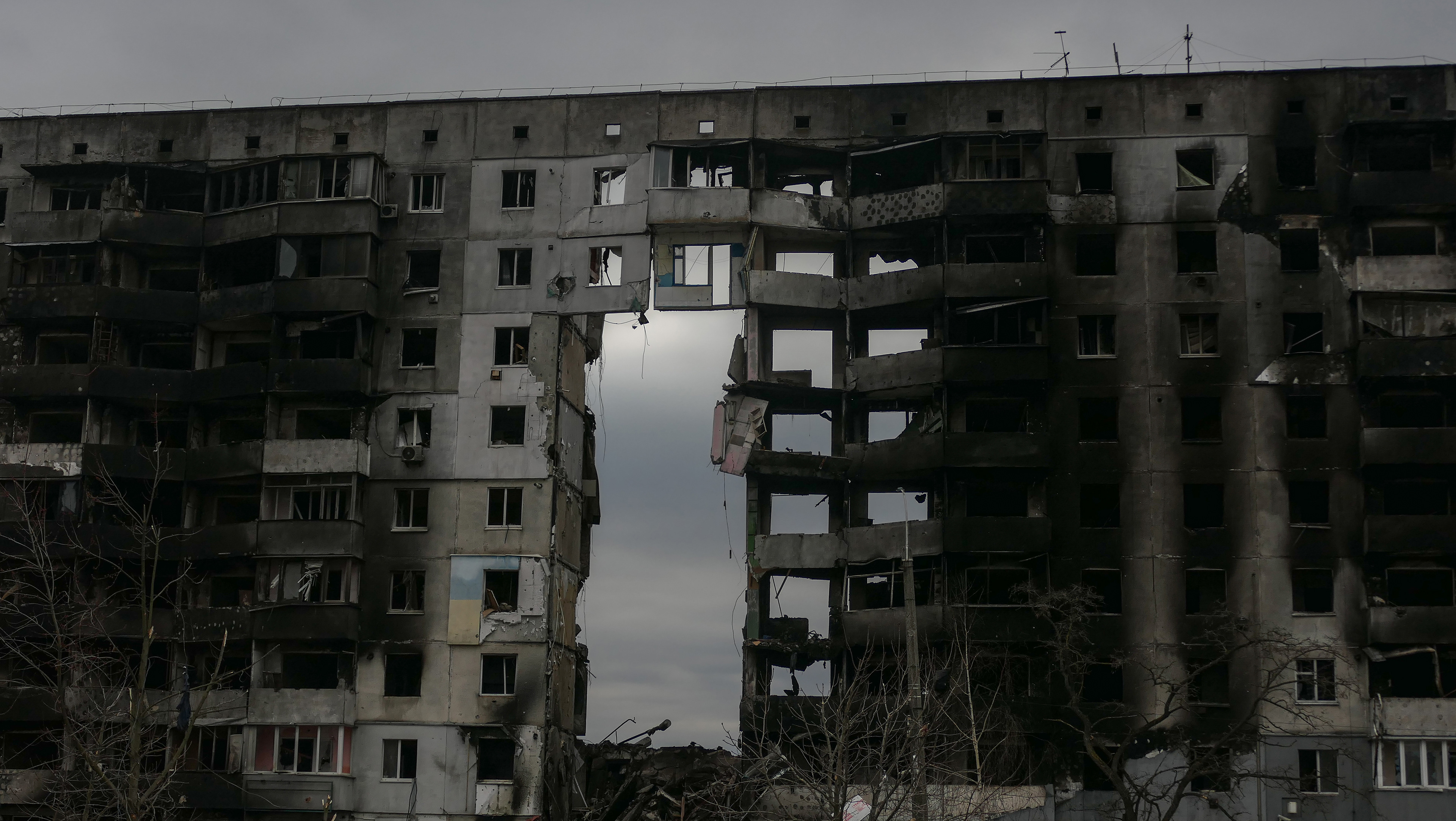
The ghost town of Pripyat, situated 3 kilometres from the Chernobyl nuclear power station, was evacuated 36 hours after the disaster, on 27 April 1986. The buildings, which remain heavily contaminated with radioactive substances, are overgrown with vegetation.

The city of Prypiat, inside the "exclusion zone".

the sports complex, which was visited daily by hundreds of local residents who worked at the power station.

The "Energetik" Palace of Culture, once a lively venue for leisure and celebrations, hosting concerts and dance classes for local residents, was put to an unexpected new use following the disaster. In 1987, it hosted an official trial against those responsible for the accident. The defendants, who included senior managers from the power station, were tried there in a hall that had been converted into a makeshift courtroom.

The "Lazurny" (azure blue) swimming pool is situated in the least contaminated area of Pripyat. It is one of the town’s iconic buildings. For twelve years after the disaster, the swimming pool remained open for the liquidators and scientists who came to clean up and study the area. The sports complex served as a refuge for those who worked and lived there under very difficult conditions. The swimming pool was finally closed in 1998, following a health inspection.

The Lazurny (‘azure blue’) swimming pool.

The playground in the town of Pripyat is situated at the heart of a 2,600-square-kilometre exclusion zone surrounding reactor number 4 at the power station, where the accident occurred on 26 April 1986. This area remains off-limits, with radiation levels in some places 3,700 times higher than normal.

Right next to the Lazurny swimming pool, on Sportivnaya Street, a basketball court completes the Pripyat sports complex.

A Przewalski's horse, the world’s last remaining species of wild horse, graze in the Chernobyl exclusion zone. This species, once common in Central Asia – particularly in Kazakhstan, China and Mongolia – had completely disappeared from its natural habitat by 1969. It was reintroduced to Chernobyl in 1998; there are now around 140 individuals in the exclusion zone.

Przewalski’s horses, the world’s last species of wild horse, in the Chernobyl exclusion zone.

A view of the new protective sarcophagus for Reactor 4, known as the New Safe Confinement, which was installed in November 2016 and is designed to last a hundred years. This project, funded by more than forty countries from the international community, is said to have cost between 1.5 and 2.1 billion euros. The structure is made up of tens of thousands of tonnes of concrete and steel.

The containment vessel at reactor number 4 was damaged by a drone strike, triggering a massive fire on 14 February 2025. Since then, experts from the International Atomic Energy Agency (IAEA) dispatched to the site to assess the damage have concluded that the protective containment structure had "lost its primary safety functions, including its containment capability".

Denis Vishnevskiy, head of the scientific department at the "Chornobyl Radiation and Ecological Biosphere Reserve", in his office. The organisation aims to preserve the ecosystems that have developed in the exclusion zone following the nuclear disaster. For the past 25 years, the scientist has been studying the effects of radiation on the flora and fauna in the area. "Studying the natural environment in Chernobyl is a bit like studying a post-human ecosystem. It’s a unique experience," he says.

Denis Vishnevskiy packs insects caught in the exclusion zone into tubes; these are similar to those found in other parts of Eastern Europe. In particular, a wide variety of beetles, ladybirds, bees and butterflies can be found in Chernobyl.

Some insect populations have survived despite the radiation. Thus, even though the environment remains hostile, certain insect species now show signs of having adapted to these extreme conditions and continue to reproduce naturally.

Denis Vishnevskiy is examining images captured by a camera trap in the Chernobyl Exclusion Zone. In 2023, the scientist recorded a population of forty-two Eurasian lynx in the area. This is the first time in over a century that this species of mammal has been sighted in the Ukrainian Polesia region, which stretches along the border with Belarus.

A radioactivity checkpoint at the exit from the Chernobyl exclusion zone. The movements of the 6,500 people who work in the zone every day – 2,500 of whom are employed at the power station itself in maintenance and security roles – are monitored on a daily basis.

The ghost town of Prypiat, situated next to the Chernobyl nuclear power station, in the heart of the exclusion zone, on 14 April 2026.